

Clinically significant depressed mood remains one of the most pressing challenges in global mental health. Although scientific understanding has advanced substantially, progress in translating research into interventions that deliver sustained impact at scale has been uneven and slow.
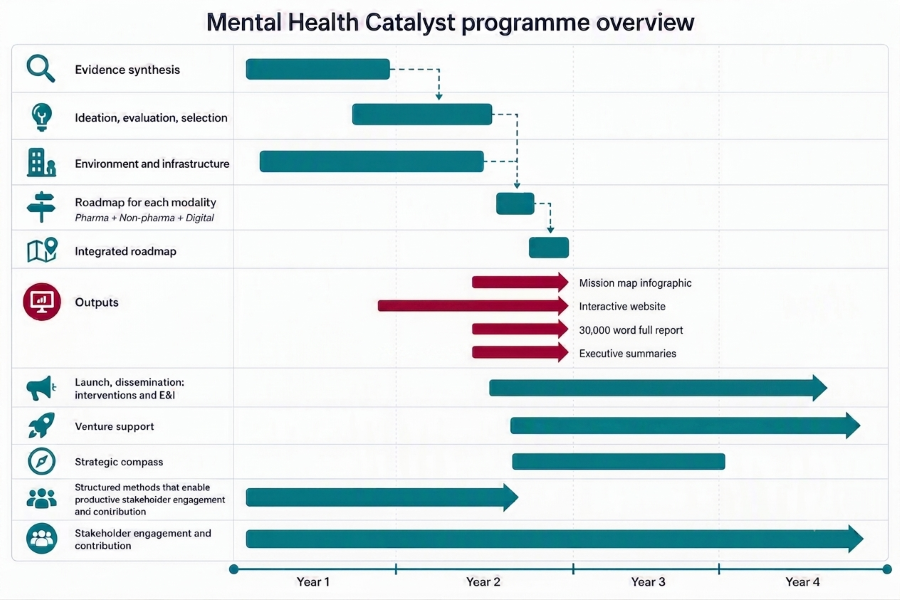
The Mental Health Catalyst has been established to help address this translational gap. The Evidence Synthesis and Pathway Mapping project is the first major evidence-building activity within Catalyst 1.0. Its purpose is to build a rigorous, transparent and reproducible evidence base that helps explain how depressed mood arises, how different risk factors and mechanisms interact, and where interventions may have the greatest potential to improve outcomes.
1. The problem
Clinically significant depressed mood includes depressive disorders, such as major depression and postpartum depression, and depressive symptoms occurring within conditions such as anxiety disorders and bipolar disorder.
Research on depressed mood spans many domains, including social and societal contexts and experiences, individual vulnerabilities, psychological processes, behaviours, lifestyle factors and biological mechanisms. However, these areas are often studied separately. As a result, it can be difficult to see how they connect, how they operate across the life course, and where interventions might most effectively interrupt the development, persistence or recurrence of depressed mood.
The challenge is therefore not simply to identify individual risk factors. Lists of risk factors are useful, but they do not show how those factors may contribute to outcomes, which mechanisms they may influence, or how different pathways may vary across contexts, populations and diagnostic conditions.
To accelerate intervention development, the Catalyst needs a more integrated understanding of the pathways through which depressed mood may arise.
2. Aims and desired outcomes
The Evidence Synthesis and Pathway Mapping project aims to create a shared evidence base that supports the identification and prioritisation of high-potential intervention opportunities.
The project seeks to:
- Build a transparent and reproducible synthesis of existing evidence on depressed mood.
- Integrate evidence across biological, psychological, behavioural, individual and socio-ecological domains.
- Understand how contexts, vulnerabilities and mechanisms interact across development and the life course.
- Identify risk factors, mechanisms and pathway interactions relevant to depressive disorders and depressive symptoms occurring in anxiety and bipolar disorders.
- Develop integrated bio-psycho-social pathway models showing how depressed mood may arise across different contexts and diagnostic conditions.
- Identify evidence-informed strategic intervention points that can support the downstream identification, prioritisation and selection of high-potential intervention opportunities.
The aim is not to produce a single simplified explanation of depression. Depressed mood is heterogeneous and may arise through multiple interacting pathways. Instead, the project will produce structured, evidence-informed models that help stakeholders understand where intervention may be possible, which mechanisms or vulnerabilities may be modifiable and where further evidence may be needed.
These outputs will provide the foundation for the next stages of Catalyst 1.0, particularly intervention ideation, prioritisation and selection, and supporting the identification of barriers to innovation and implementation across environments and infrastructure.
3. Description of the methodology
The methodology combines structured evidence review with pathway modelling. Each pathway will be traceable back to the evidence on which it is based.
The work follows a structured four-stage approach:
Stage 1: rapid overview of reviews
The first stage identifies relevant review-level evidence on risk factors, mechanisms and pathways associated with clinically significant depressed mood. This establishes the primary human evidence foundation for the project.
Where available, the review-level evidence captures information such as the direction of association, effect estimates, certainty of evidence and narrative findings from qualitative syntheses. This stage provides the strongest basis for understanding what is already known across the research literature.
Stage 2A: rapid scoping review of recent primary human studies
Some newer findings may not yet have been captured in systematic reviews. The second stage therefore examines recent primary studies in humans to identify emerging risk factors, mechanisms or pathways that may not yet appear in review-level evidence.
This stage complements, rather than replaces, the overview of reviews. It helps ensure that the Catalyst does not overlook promising recent evidence, while recognising that scoping reviews do not provide the same level of certainty assessment as systematic reviews.
Stage 2B: selective review of animal studies
A complementary animal-study component is used selectively where it can help address mechanistic gaps, particularly within biological domains that cannot be investigated directly in humans.
These findings are interpreted cautiously. Animal studies are not treated as direct evidence of clinical effect in humans. Instead, they may help support biological plausibility or generate hypotheses about intermediate mechanisms. Any animal-derived findings will be explicitly labelled and their transferability to humans will be reported transparently.
Stage 3: Context–Mechanism–Outcome mapping
The third stage organises the evidence into Context–Mechanism–Outcome, or CMO, configurations. In simple terms, these describe how particular mechanisms may operate in particular contexts and be linked to depressive outcomes.
For example, a context might include chronic stress, early-life adversity or social isolation. A mechanism might include HPA-axis dysregulation, inflammatory signalling, rumination, negative cognitive bias, reward processing disruption, sleep or circadian disruption, or social withdrawal. The outcome is a depressive outcome, such as depressive symptoms or depressive disorder.
CMO mapping helps move beyond simple associations. It provides a structured way to examine how particular factors may act through specific mechanisms, in particular populations or contexts, to contribute to depressed mood.
Stage 4: pathway modelling
The final stage integrates CMO configurations into broader pathway models. These models show how depressed mood may arise across different life contexts, developmental stages and diagnostic conditions.
The pathway models are exploratory. They do not claim to prove causality. Rather, they provide structured syntheses of associations and plausible mechanisms, with clear traceability back to the underlying evidence.
This stage uses root-cause analysis: starting from depressive outcomes and working backwards to identify the mechanisms and risk factors that may contribute to those outcomes.
The pathways are represented as process flow diagrams. These linked visual representations help stakeholders identify where interventions might be most strategically targeted.
4. From pathway insight to intervention opportunities
The purpose of pathway mapping is not only to organise the evidence, but to make it useful for innovation.
By linking risk factors, contexts, mechanisms and outcomes, the project helps identify where change may be possible. Some intervention points may sit upstream, addressing social, behavioural or lifestyle vulnerabilities that increase risk. Others may target intermediate biological, psychological or behavioural mechanisms, such as stress-system dysregulation, inflammatory signalling, rumination, reward processing, sleep disruption or social withdrawal. Others may focus further downstream, improving treatment response, preventing relapse or supporting sustained recovery.
This pathway-based approach helps the Catalyst ask more precise questions:
- Which mechanisms appear to be important across more than one context or condition?
- Which risks or mechanisms may be modifiable?
- Where might intervention have the greatest potential to reduce burden, improve recovery or prevent recurrence?
- Which opportunities are ready for development and validation, and which require further research?
- What contextual factors may affect whether an intervention is acceptable, feasible and scalable?
The resulting strategic intervention points will provide a structured starting point for the Catalyst’s innovation process. They will inform the identification, prioritisation and selection of potential interventions across pharmaceutical, digital and non-pharmaceutical approaches, helping to ensure that intervention development is grounded in a clear, evidence-informed understanding of how depressed mood may arise, persist and recur.