


Please complete the form below to receive more information and updates on how you can support us:

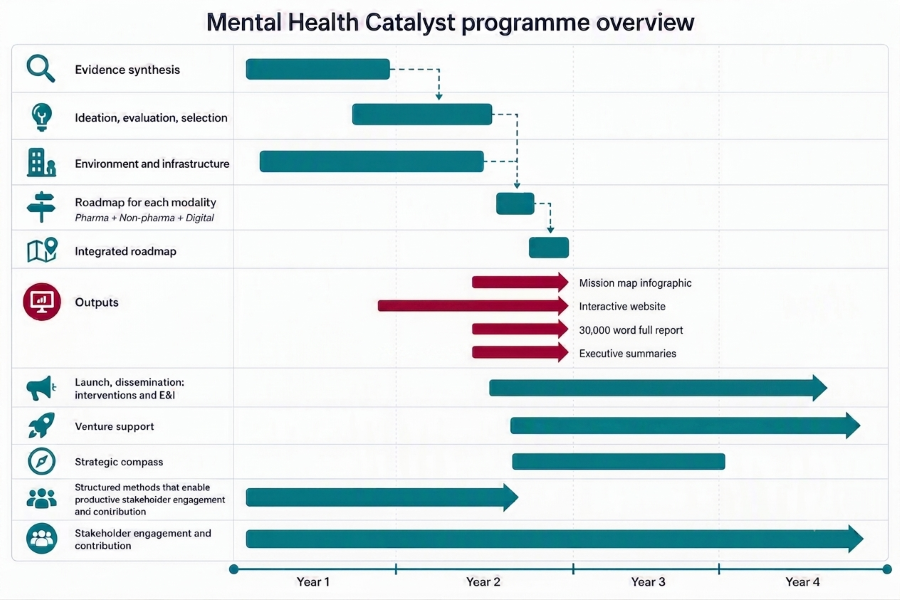
Commissioned by Wellcome, the Mental Health Catalyst is a structured, end-to-end programme designed to:
Clinically significant depressed mood remains one of the most pressing challenges in global mental health. Despite major advances in scientific understanding, progress in translating research into interventions that deliver sustained real-world impact has remained uneven and slow. The Mental Health Catalyst has been established to help accelerate the development and adoption of more effective, scalable and sustainable interventions that can meaningfully improve outcomes.







Progress is often constrained by fragmented knowledge, weak prioritisation, poor alignment between innovation and delivery systems, and barriers within policy, infrastructure and implementation.
Addressing these challenges requires coordinated approaches that integrate scientific understanding, structured innovation and real-world implementation to accelerate meaningful and sustained improvements in outcomes.


Head of Mental Health Innovation, Wellcome
Developed through more than seven years of collaboration between the University of Cambridge’s Institute for Manufacturing (IfM), IfM Engage and The William Templeton Foundation for Young People’s Mental Health (YPMH), the Understand : Innovate : Implement methodology integrates evidence synthesis, structured innovation, systems thinking and implementation-focused change management.

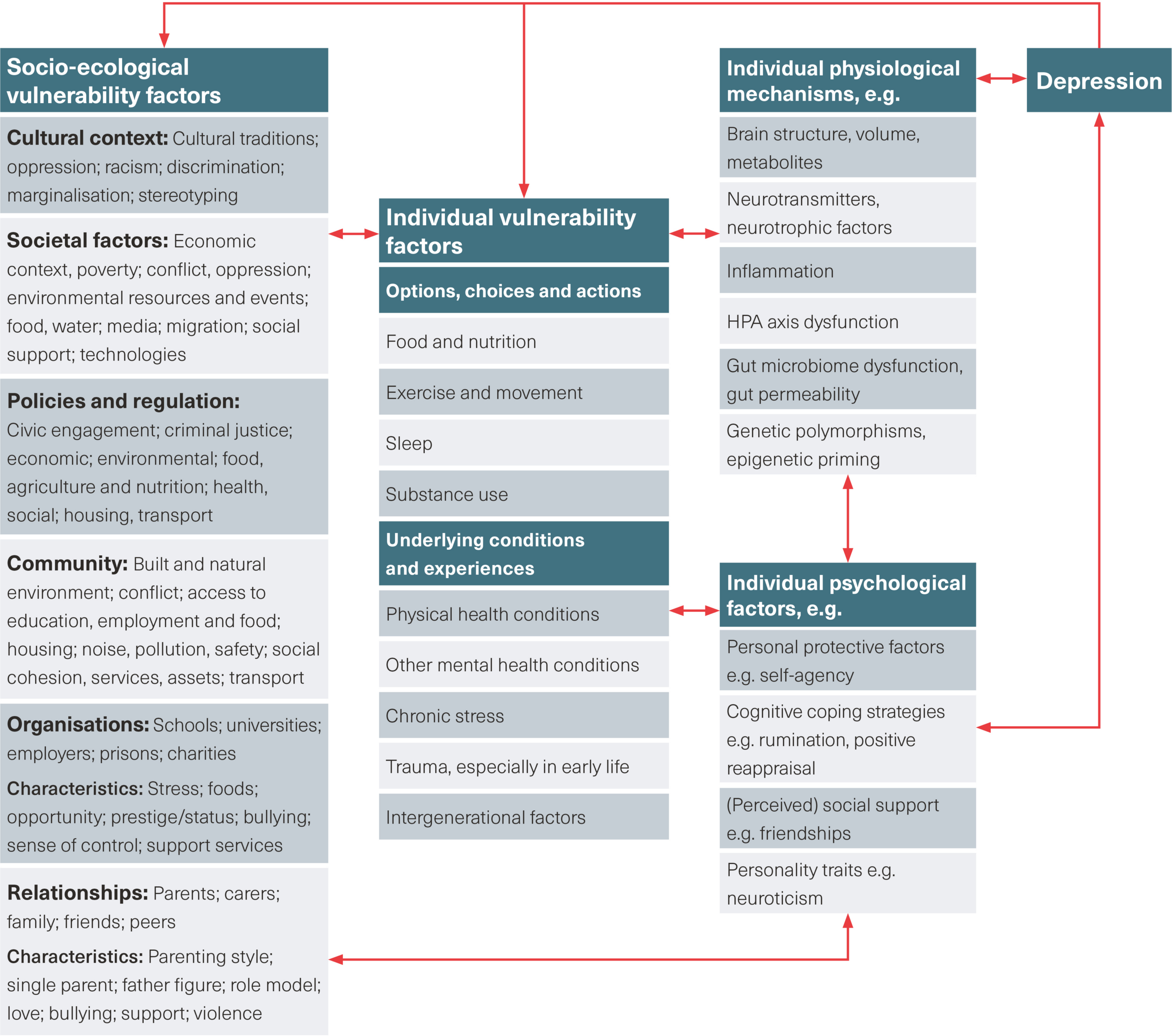
Understand focuses on clarifying the pathways, factors and mechanisms contributing to depressed mood, helping identify evidence-informed opportunities for intervention

Innovate focuses on identifying and prioritising promising intervention opportunities with the potential to meaningfully improve outcomes

Implement focuses on enabling effective interventions to be adopted, scaled and sustained through implementation design, behaviour change and coordinated action across health systems and wider societal ecosystems.

The Mental Health Catalyst aims to make clinically depressed mood a short-lasting condition that does not affect lives in the longer term through the development and adoption of more effective, faster-acting and longer-lasting interventions that can be sustainably delivered at scale.
Catalyst 1.0 is a four-year programme focused on identifying prioritised, evidence-informed intervention opportunities for clinically significant depressed mood, including depressive disorders and depressed mood occurring within anxiety disorders and bipolar disorder. The programme is principally treatment-focused, aiming to identify interventions that are acceptable, faster-acting, scalable and capable of reducing relapse and improving longer-term outcomes.
At the same time, the programme examines the biological, psychological and socio-ecological pathways contributing to depressed mood across the life course, helping identify opportunities relevant to prevention, early detection, diagnosis and stratified approaches to management and treatment.
Looking ahead, Catalyst 2.0 aims to build global capability for translating mental health research into scalable real-world impact.
Partnership is embedded throughout the programme, enabling deeper insight, co-development of solutions and coordinated approaches for translating research into real-world impact.
The Catalyst brings together researchers, clinicians, health strategists, innovators, policymakers, funders and people with lived experience to help accelerate the development and adoption of interventions that can improve outcomes for people experiencing mental ill health.
We warmly invite individuals and organisations to contribute in several ways:
Your expertise, experience and partnership can help shape evidence-informed approaches that deliver meaningful improvements in mental health outcomes.
To learn more or explore opportunities to collaborate, please contact the Catalyst team at mhc-enquiries@eng.cam.ac.uk.




Loading…