

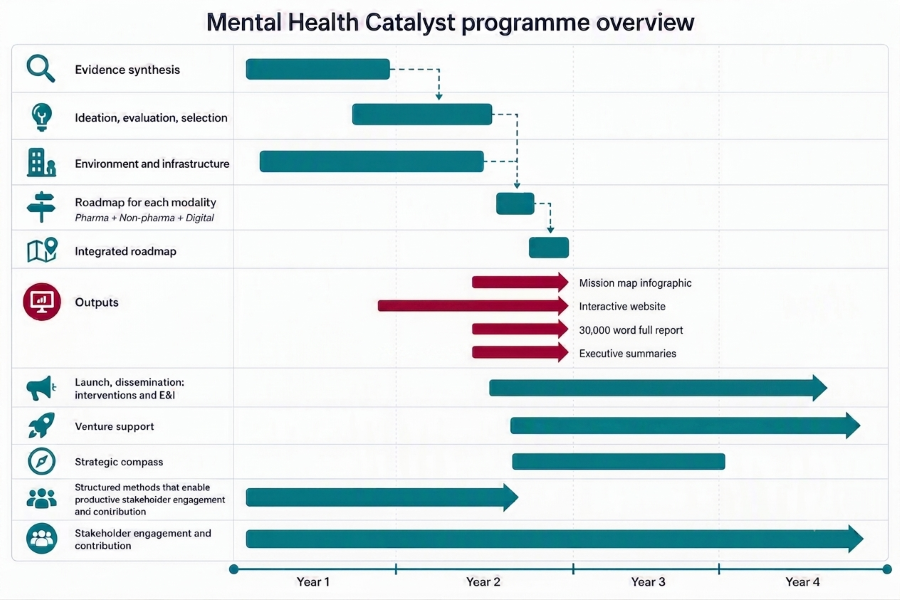
Mental Health Catalyst 1.0 is a four-year programme commissioned by Wellcome to accelerate the development, translation and uptake of new and better interventions for conditions associated with depressed mood.
Catalyst 1.0 comprises a programme of work packages which are outlined below. Further details can be found in the Mental Health Catalyst booklet, which can be downloaded from the website.
1. Establishing the foundations for the Mental Health Catalyst
The first work package established the foundations for delivering a complex, four-year, multi-partner programme.
This included setting up the programme team, governance arrangements, working methods and delivery structures across the Catalyst partnership. It also involved confirming the programme scope, clarifying roles and responsibilities, defining key performance indicators and preparing core materials to explain the Catalyst’s purpose, approach and planned activities.
This work package created the operating platform for the next phase of work: building a shared evidence base, identifying high-potential intervention opportunities and understanding what is needed to translate promising approaches into real-world impact.
2. From evidence to Mission Map
Work package 2 consists of the following linked projects.
2.1 Evidence synthesis and pathway mapping
This project brings together the best available evidence on risk factors, mechanisms and pathways for conditions associated with depressed mood. These include depressive disorders, such as major depressive disorder and postpartum depression, and depressive symptoms occurring within anxiety disorders and bipolar disorder.
The project has four stages:
Stages 1 and 2 – Establishing the evidence: conducting an overview of existing reviews, rapid scoping of recent human studies and selective review of relevant preclinical evidence.
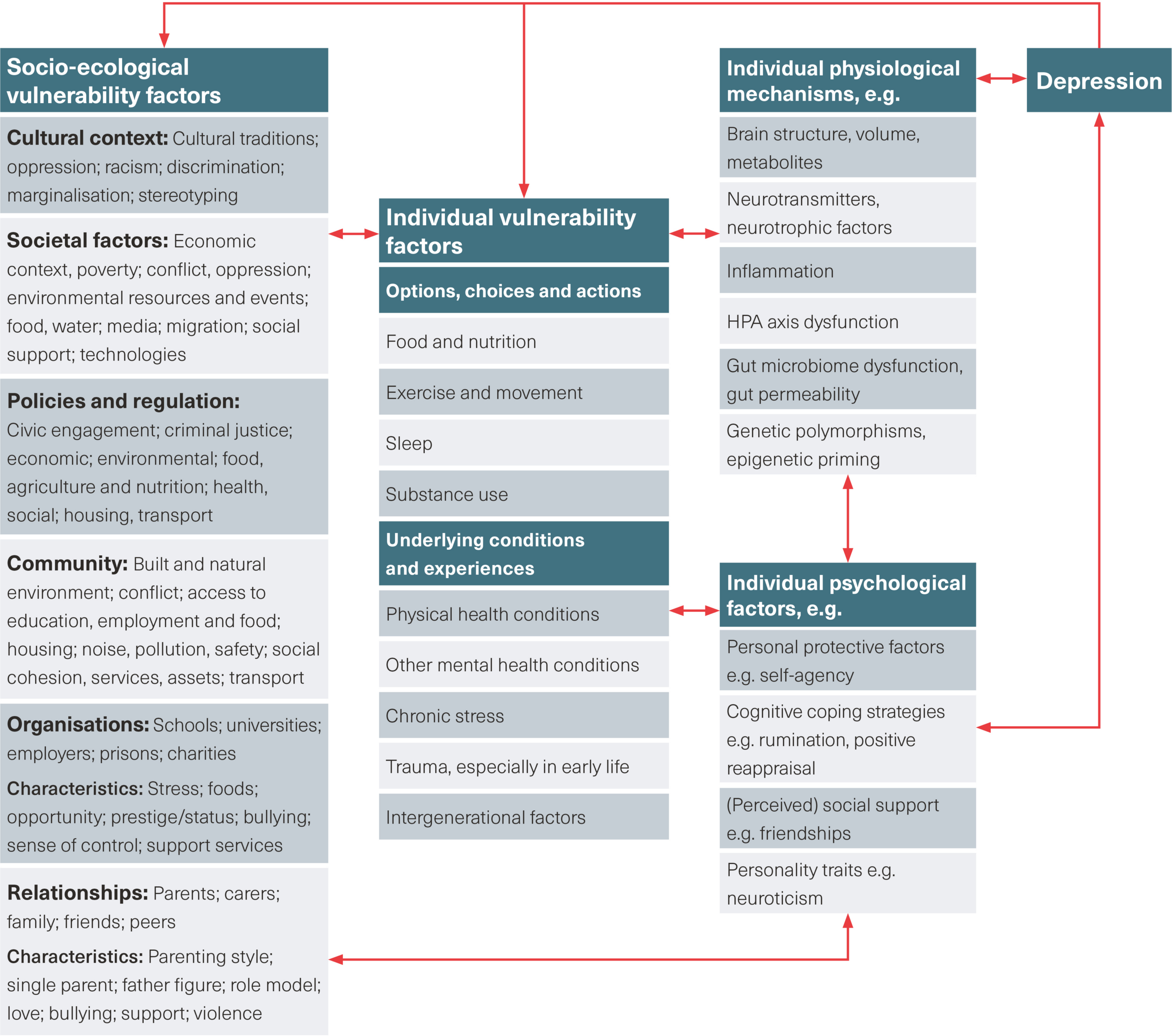
Stages 3 and 4 – Mapping mechanisms and pathways: integrating evidence from Stages 1 and 2 to identify links between risk factors, contexts, mechanisms and outcomes. Stage 3 uses Context–Mechanism–Outcome modelling to describe how particular factors may operate in specific contexts. Stage 4 links these models, where supported by the evidence, into pathway diagrams. These pathways connect socio-ecological and individual factors with the biological, psychological and behavioural mechanisms through which they may act, helping to identify evidence-informed strategic intervention points.
The aim is to create a robust, shared evidence base to inform the later identification, prioritisation and selection of high-potential intervention opportunities.
2.2 Identifying and prioritising intervention opportunities
This project uses the outputs from evidence synthesis and pathway mapping to identify, evaluate and prioritise high-potential intervention opportunities. It will consider where there may be strong scientific rationale, unmet need, feasibility, potential for impact and readiness for further development.
The output will be a clearer set of priority areas for innovation and investment.
2.3 Environments and infrastructure for translation
Promising interventions often fail to reach people because the surrounding environment is not ready to support innovation, implementation, adoption and scale-up. This project examines the practical, organisational, workforce, policy, commissioning, digital, regulatory, market and other conditions needed to translate interventions into real-world use.
The project applies a structured methodology to engage stakeholders from across the global mental health ecosystem to:
- identify barriers that inhibit the development, validation, scaling and sustainable implementation of interventions
- prioritise the most significant barriers across pharmaceutical, digital and other modalities, care stages and high-, middle- and low-income contexts
- identify enabling solutions capable of addressing these barriers
- inform Catalyst roadmaps so they address not only promising interventions, but also the conditions required for their successful adoption and sustained impact.
The output will be a clearer understanding of the barriers, enablers and infrastructure requirements that need to be addressed if the Catalyst is to accelerate meaningful progress.
2.4 Roadmapping – translating insight into coordinated action
A key barrier to innovation and adoption at scale is fragmentation across the mental health ecosystem. To date, there has been no clear stakeholder-agreed vision for interventions, enabling environments and the steps needed to build them.
Roadmapping is a strategic planning technique developed and applied extensively by the Institute for Manufacturing and IfM Engage. It brings stakeholders together to create a shared vision, map the current state and identify practical steps towards a chosen future.
This project brings together the outputs of two prior work packages:
- prioritised intervention opportunities and portfolios identified through the intervention ideation, prioritisation and selection process
- barriers and enabling solutions identified through the environments and infrastructure analysis.
Using these inputs and facilitated online roadmapping workshops, stakeholders will explore possible futures for addressing depressed mood and identify practical pathways for developing, validating and scaling interventions.
The resulting three modality-specific roadmaps and single integrated roadmap will define a chosen future, map the current state, and identify the stepping stones and enabling conditions required to move from the present to that chosen future.
2.5 Mission Map reporting
This project turns the outputs from the prior projects into clear, accessible Mission Map outputs for different audiences. These include reports, summaries, visual materials and stakeholder-facing resources.
The aim is to ensure that the Catalyst’s findings are useful, actionable and capable of informing future research, innovation, funding and implementation decisions.
2.6 Interactive web platform
The interactive web platform will provide a public-facing home for the Catalyst’s outputs, updates and resources. It will support dissemination of the Mission Map, explain the programme’s approach, share emerging insights and help stakeholders understand how they can contribute to the development and uptake of new and better interventions for depressed mood.
3. Launch, engagement and uptake
Following development of the Mission Map, supporting outputs and interactive web platform, this work package will focus on launch, engagement and uptake.
Outputs will include in-person, online and public launch events, webinars, conference engagement, papers and publications.
The key aims are to establish:
- shared understanding across the mental health ecosystem of risk factors and mechanisms, intervention opportunity areas, potential targets and priority interventions
- collaborations and projects to explore, develop, validate, adopt, scale and sustain interventions
- improvements to environments and infrastructure that enable better interventions to be developed, validated, adopted, scaled and sustained more effectively and efficiently.
The aim is for Catalyst methods, frameworks and outputs to be used across the mental health ecosystem to support more effective understanding, innovation and implementation.
In addition, IfM Engage’s Strategic Compass innovation and commercialisation methodology will be piloted with one intervention in each modality. Strategic Compass has been applied with more than 400 high-potential new ventures across 26 countries.
The pilot will explore whether structured innovation and venture-support workshops can help teams clarify their vision and goals, build consensus, strengthen action plans, mitigate risks and accelerate promising interventions towards development, validation and scale.